


Quick Summary
- Surface cracks and oxidation are cosmetic — they’re fixable with sealcoating or crack sealing. Severe alligator cracking, rutting, and water pooling that won’t drain signal a failed subbase that requires full-depth replacement.
- Denver’s Front Range freeze-thaw cycles and high-altitude UV exposure accelerate subbase deterioration faster than in most U.S. markets — making early, accurate diagnosis critical to protecting your property investment.
- Before calling a contractor, you can run a simple DIY deflection test on your parking lot to gauge structural severity and walk into any estimate conversation with confidence.
You’re standing in your parking lot. There are cracks everywhere —some thin and spidery, others wide and scaly like a dried riverbed. A contractor just told you the whole thing needs to come out and be rebuilt from scratch. Another one says a sealcoat will fix it.
Who’s right?
The honest answer is: it depends on where the failure starts. A parking lot can look terrible on the surface and still have a structurally sound foundation. It can also look passable while quietly collapsing underneath. Knowing the difference is the most important thing you can do before you spend a dollar on repairs.
Here’s how to tell.
What Your Asphalt Is Actually Made Of (And Why It Matters)
Think of your parking lot like a layer cake. The top layer —the asphalt surface you drive on— is only 2 to 4 inches thick. Below that sits the base course (compacted aggregate), and below that, the ` and native subgrade soil. The whole system works together to distribute load and drain water away from the structure.
When the surface deteriorates, you’re dealing with a cosmetic problem. When the subbase fails, you’re dealing with a structural one.
Treating a structural failure with a surface fix is like painting over a rotting wall. It looks fine for a season — and then it’s worse than before.
Surface Wear vs. Subbase Failure: How to Read the Signs
Signs of Surface-Level Wear (Usually Treatable)
These symptoms indicate the top layer of asphalt is oxidizing, drying out, or experiencing minor stress — but the foundation underneath is likely still intact:
- Fine, hairline cracks running in relatively straight lines across the surface
- Surface raveling — the top layer looks rough, sandy, or is losing aggregate
- Gray or faded color from UV oxidation (Denver’s high-altitude sun accelerates this significantly)
- Minor isolated cracks that don’t connect into a pattern
If this is what you’re seeing, [treating minor surface oxidation with professional asphalt sealcoating] is often the right move. Catching it early extends pavement life by years.
Signs of Subbase Failure (Requires Structural Assessment)
These symptoms point to something wrong beneath the surface — in the base course, subbase, or subgrade soil:
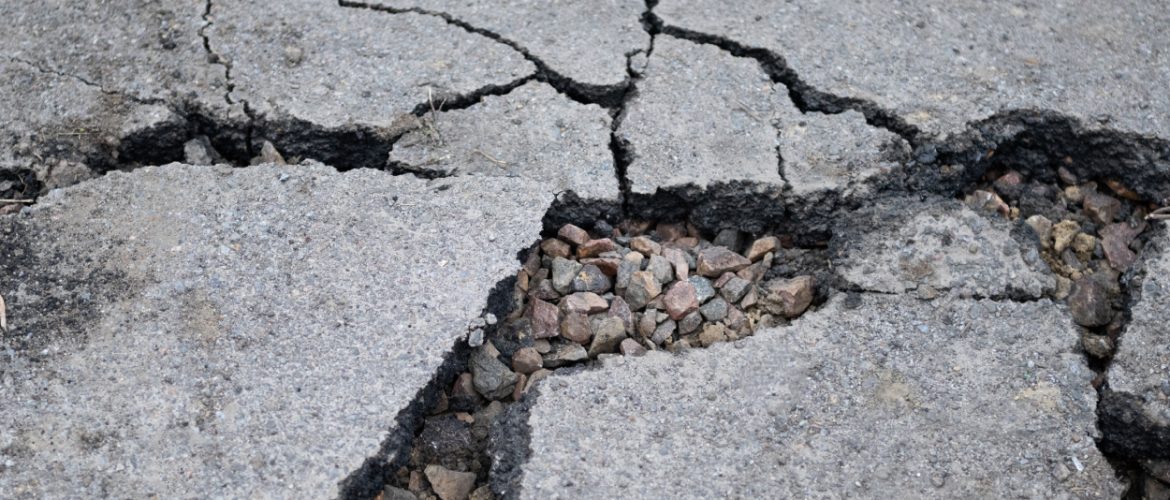
- Alligator (fatigue) cracking — interconnected cracks forming a scaly, reptile-skin pattern across large sections. This is the most reliable visual indicator of base failure.
- Rutting or depression — visible ruts or low spots that hold water after rain or snowmelt
- Heaving or frost boils — sections of pavement that have pushed upward, a classic sign of freeze-thaw damage to the subgrade
- Potholes that keep coming back — especially after a winter or spring thaw
- Pavement that feels “spongy” or flexes slightly under the weight of a vehicle
In Denver and across the Front Range, freeze-thaw cycles are the primary accelerant here. Water infiltrates a crack, freezes, expands, and forces the crack wider. Over repeated cycles, it works its way down into the base and subgrade — compromising the compaction that holds everything together.
The DIY Deflection Test: What to Do Before You Call Anyone
Before you get a single estimate, you can run a quick field test that gives you a meaningful data point on structural integrity.
Here’s how:
- After a rain or snowmelt event, walk your lot and mark any areas where water is pooling rather than draining. Persistent pooling in the same spots — especially in the field of the lot rather than along edges — suggests the surface has deflected and the base beneath has shifted or settled.
- Have a heavy vehicle (a loaded delivery truck or your largest maintenance vehicle) drive slowly over the suspect areas. Watch the surface carefully. If the asphalt visibly flexes or “waves” under the load, the base is no longer providing adequate support. A structurally sound section won’t move.
- Note whether any cracked sections are depressed relative to the surrounding pavement. Vertical displacement — even a quarter inch — is a meaningful structural signal.
This isn’t a replacement for a professional core test, but it gives you an objective baseline to bring to any contractor conversation. If the pavement doesn’t flex and water drains properly, you’re likely dealing with a surface issue. If it does, you need a structural assessment.
Why Denver’s Climate Makes This Diagnosis More Urgent
Most of the continental U.S. sees 10–20 freeze-thaw cycles per year. Denver and the Front Range can see 50 or more, depending on elevation and the season. That’s 50 opportunities for water to expand inside a crack, deepen it, and migrate toward the subbase.
Add high-altitude UV exposure — which oxidizes and embrittles the asphalt binder faster than at lower elevations — and you have a surface that becomes water-permeable more quickly than in most markets.
The Colorado Department of Transportation (CDOT) sets specific subbase compaction and aggregate standards for this reason. Properly engineered pavement in Colorado requires compacted aggregate base material that meets strict gradation and density specifications, specifically to resist the lateral movement and frost heave that our climate produces.
When those standards aren’t met during original construction — or when water infiltration compromises the compaction over time — the subbase loses its load-bearing capacity. That’s when surface repairs stop working.
When a Surface Repair Is Appropriate — and When It Isn’t
Let’s be direct about this, because it’s where a lot of property managers get burned.
An asphalt overlay or sealcoat is appropriate when:
- Cracking is limited to the surface layer with no alligator pattern
- The pavement passes the deflection test (no flex, adequate drainage)
- The base course is still intact and well-compacted
Full-depth patching or Asphalt Removal & Replacement is necessary when:
- Alligator cracking covers more than 25–30% of a section
- The pavement deflects under load or shows vertical displacement
- Rutting or heaving is present
- Water is consistently pooling in the field of the lot
Paving over a failed subbase is something we won’t do. It’s not a cost-effective shortcut — it’s a guarantee that the new surface will fail within 1–3 years, and you’ll be back to square one with a larger repair bill. Understanding [when to choose full-depth patching over surface overlays] protects your budget far better than a cheap overlay that doesn’t address the root cause.
What a Professional Subbase Assessment Actually Looks Like
If your DIY test raises red flags, the next step is a thorough site evaluation. A qualified paving contractor should be evaluating your parking lot’s drainage and grading as part of any structural assessment — not just looking at the surface.
A proper evaluation includes:
- Core sampling — extracting a cylindrical plug of pavement to physically measure layer thickness and inspect the base material condition
- Drainage analysis — assessing whether water is moving away from the structure or infiltrating it
- Subgrade soil evaluation — checking for clay content, moisture levels, and compaction depth, all of which affect load-bearing capacity
- Load and traffic review — understanding what the pavement is actually carrying versus what it was designed to carry
At Foothills Paving & Maintenance, Inc., this thorough preparation is the foundation of every detailed written proposal we provide. It eliminates surprises, ensures accurate project specifications, and gives you the technical documentation you need to justify capital expenditure to ownership or a board.
Conclusion: Know What You’re Dealing With Before You Spend a Dollar
The most expensive mistake a property manager can make isn’t choosing full-depth replacement — it’s choosing a surface fix on a structural problem and having to do the whole thing over again in two years.
Take 20 minutes to walk your lot, run the deflection test, and document what you find. If the signs point to subbase failure, get a core test done before you accept any proposal. And if a contractor won’t do a thorough site evaluation before quoting you, that tells you everything you need to know.
With over 25 years of experience diagnosing and repairing commercial pavement across Denver, the Foothills, and Northern Colorado, the team at Foothills Paving & Maintenance, Inc. is here to give you a straight answer — not a sales pitch.
Ready for an honest assessment of your parking lot? Call us at 303-462-5600 or schedule your free, no-obligation estimate today. Our team is available Monday–Friday, 8:00 am–5:00 pm, and we serve the entire Denver metro area from our Wheat Ridge office.
Frequently Asked Questions
What are the first signs of asphalt subbase failure?
The earliest and most reliable visual sign is alligator (fatigue) cracking — an interconnected pattern of cracks resembling reptile scales covering a large section of pavement. Rutting, persistent water pooling in the field of the lot, and pavement that visibly flexes under vehicle load are also strong indicators that the base course or subgrade has lost structural integrity.
Can you pave over a failing subbase?
No, not effectively. Applying an asphalt overlay or sealcoat over a failed subbase will appear to resolve the issue temporarily, but the underlying movement and moisture infiltration will cause the new surface to crack and fail within one to three years. The only lasting solution is to remove the deteriorated material, correct the drainage and compaction issues in the subbase, and rebuild from a structurally sound foundation.
What causes a pavement subbase to fail?
The most common causes are water infiltration, inadequate original compaction, and freeze-thaw cycling. In Denver and along the Front Range, pavement is particularly vulnerable because of the high number of annual freeze-thaw cycles (50+) and high-altitude UV exposure that accelerates surface oxidation and water penetration. When water enters the base course and repeatedly freezes and expands, it displaces aggregate, reduces compaction density, and progressively destroys the load-bearing capacity of the foundation.