


Quick Summary
- Colorado’s extreme diurnal temperature swings — sunny 60°F afternoons dropping to 15°F overnight — force water to expand in asphalt micro-fractures up to 9% in volume, destroying pavement from the inside out.
- Standard national paving advice fails on the Front Range because it ignores high-altitude UV degradation and the rapid melt-refreeze cycle unique to Denver’s climate.
Preventing this damage requires commercial-grade sealcoating chemistry, proper subbase preparation, and a proactive maintenance plan — not reactive patching after the damage is done.
Your parking lot looked fine in October. By March, it’s a minefield of cracks, heaving slabs, and potholes that are costing you complaints, liability exposure, and another repair bill.
You’re not imagining it. And it’s not bad luck. What’s happening beneath your asphalt is a relentless, physics-driven process — one that Colorado’s unique climate accelerates faster than almost anywhere else in the country. If you’ve been patching the same spots year after year, this article will finally explain why those patches keep failing, and what it actually takes to stop the cycle.
How Water Gets Inside Your Pavement in the First Place
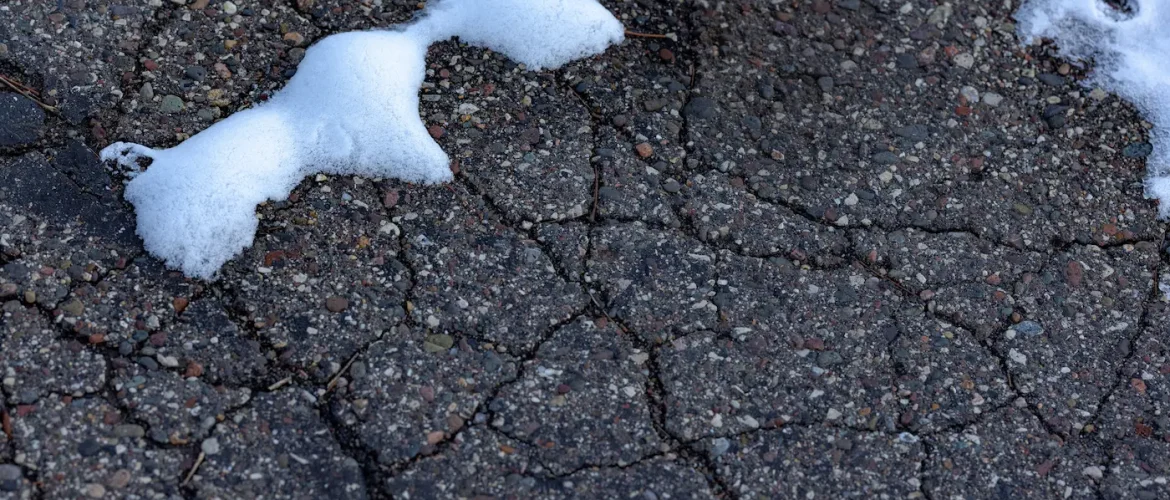
Healthy asphalt looks solid, but it’s not impermeable. Over time — and especially under Colorado’s intense UV exposure at altitude — the surface oxidizes and becomes brittle. Small surface cracks form. Most property managers don’t think much of them.
That’s the mistake.
Those hairline cracks are open doors. Every time it rains or snow melts, water seeps down through the surface layer and into the subbase below. On a mild, wet day in, say, Ohio, that water might just drain away. In Denver, it doesn’t get that chance.
The Front Range’s high-altitude sun means pavement surfaces absorb more UV radiation year-round, accelerating the oxidation that opens those micro-fractures in the first place. By the time you can see surface cracking, water infiltration into the subbase has likely already begun.
The Real Culprit: Denver’s Diurnal Temperature Swing
Here’s where Colorado becomes a different animal entirely.
Picture a Tuesday in January on the Front Range. By 2 PM, it’s a sunny 62°F — warm enough that snow on your parking lot is actively melting, sending water directly into every crack and crevice in your asphalt. Then the sun drops behind the mountains. By midnight, it’s 14°F.
That water — now trapped inside your pavement’s micro-fractures and subbase — freezes solid. And when water freezes, it expands by approximately 9% in volume.
Think of it like this: imagine forcing a wooden wedge into a crack in a rock, then hammering it. Every freeze cycle is that hammer. Every thaw cycle pulls the wedge out just enough for more water to get in deeper before the next freeze drives it further.
This isn’t a gradual process. Denver’s rapid diurnal swings mean this expansion-contraction cycle can happen multiple times in a single week — sometimes within a single 24-hour period during shoulder seasons. National pavement guidelines, written for climates that freeze once and stay frozen, simply don’t account for this.
The result? Pavement heaving, accelerating crack networks, and subbase failure that no surface patch will fix.
Why Cheap Patches Fail After One Colorado Winter
If you’ve hired a budget contractor and watched their work crumble by spring, you’ve experienced this firsthand. Here’s the technical reason it happened.
Standard cold-patch or surface-fill repairs don’t address the subbase. They fill the visible void, but the compromised material underneath — saturated, weakened, and structurally unsound — continues to shift with every freeze-thaw cycle. The patch has nothing solid to bond to.
Proper repair in a Colorado freeze-thaw environment requires:
- Full-depth assessment of subbase conditions before any surface work begins
- Removal of compromised material down to a stable, dry substrate
- Infrared thermal bonding that fuses new material to existing asphalt at a molecular level, eliminating the cold seams where water re-enters
- Premium hot-mix asphalt formulations specifically engineered for Colorado’s climate and traffic load
- Rigorous quality control inspection before the lot reopens
Skipping any of these steps doesn’t save money. It just moves the cost to next spring.
The Preventative Measures That Actually Work in Colorado
Reactive repair is always more expensive than prevention. Here’s what a properly engineered protection strategy looks like for a commercial property on the Front Range.
1. Crack Sealing Before Winter
The single highest-ROI maintenance task you can perform. Sealing cracks in late summer or early fall — before the first freeze — cuts off water infiltration at the source. Use a commercial-grade, rubberized sealant rated for extreme temperature flex, not the hardware store variety.
2. Commercial-Grade Sealcoating
Not all sealcoats are equal. [Commercial-grade sealcoating chemistry](link to sealcoating service page) uses coal tar or asphalt-emulsion formulations with UV inhibitors and flex additives that resist Colorado’s high-altitude oxidation. A standard residential sealcoat will degrade faster than the pavement it’s supposed to protect.
3. Infrared Thermal Repair for Existing Damage
Where damage has already occurred, infrared thermal bonding is the gold standard. The process reheats existing asphalt to 325°F, allowing new material to be seamlessly integrated without cold joints. There’s no seam for water to exploit. It’s not a patch — it’s a structural restoration.
4. A Proactive 5-Year Maintenance Plan
This is the piece most property managers are missing. A custom five-year maintenance program — with scheduled crack sealing, sealcoating intervals, and condition assessments — transforms your pavement budget from unpredictable emergency spending into a controlled capital expenditure line. You stop reacting to failures and start preventing them.
At Foothills Paving & Maintenance Inc., our comprehensive maintenance solutions are built around this framework. We’ve spent over 25 years learning exactly what Colorado’s climate demands, and our programs are designed to protect your property from Colorado winters before the damage starts.
A Front Range Property That Got It Right
One Denver commercial property manager came to us after two consecutive winters of catastrophic parking lot failure. Their previous contractor had surface-patched the same section three times in 18 months. Each repair lasted one season.
Our team conducted a detailed site evaluation — assessing drainage patterns, subbase depth, existing crack networks, and traffic load. The diagnosis: the subbase had been compromised by years of water infiltration, and surface repairs were never going to hold.
We performed full-depth patching in the critical failure zones, applied infrared thermal bonding to the surrounding transition areas, and sealed the entire lot with commercial-grade sealant before the first hard freeze. We then enrolled the property in a five-year maintenance program with annual condition assessments.
Two winters later, the lot is intact. No emergency repairs. No pothole complaints. With a predictable maintenance budget, the property manager can actually plan around.
That’s what engineered solutions look like versus reactive patching.
Stop Patching. Start Protecting.
The Colorado freeze-thaw cycle isn’t going to get easier on your pavement. If anything, the Front Range’s pattern of extreme diurnal swings makes every season a stress test that most asphalt — and most contractors — aren’t prepared for.
The good news is that the damage is preventable. With the right materials, the right repair methods, and a proactive maintenance plan built for Colorado’s climate, your commercial pavement can survive and outlast the harshest winters on the Front Range.
The question isn’t whether you can afford to invest in proper pavement protection. It’s whether you can afford another season of reactive patching.
Ready to stop the cycle? Contact the team at Foothills Paving & Maintenance Inc. for a thorough site evaluation and a detailed written proposal — no vague estimates, no hidden costs, no surprises.
Call us at 303-462-5600
Monday–Friday, 8:00 AM – 5:00 PM
5040 Tabor St., Wheat Ridge, CO
Or schedule your free, no-obligation estimate today.
Frequently Asked Questions
Significant and cumulative. Each freeze-thaw cycle forces water trapped in micro-fractures to expand by approximately 9% in volume, widening cracks and destabilizing the subbase. In Denver’s climate — where this cycle can repeat multiple times per week during shoulder seasons — pavement that isn’t properly sealed and maintained can deteriorate years ahead of its expected service life. Untreated commercial lots often require full replacement 5–8 years earlier than properly maintained ones.
Water begins to freeze at 32°F, but the real damage threshold on the Front Range is the speed of the temperature drop. Denver’s diurnal swings — where afternoon temperatures can reach 55–65°F, melting snow directly into surface cracks, then plunge below 20°F overnight — create the ideal conditions for rapid, repeated freeze-thaw stress. The faster the temperature drops, the less time water has to drain before it freezes and expands inside the pavement structure.
For commercial properties in the Denver metro and Front Range, crack sealing should be performed annually — ideally in late summer or early fall, before temperatures drop below 50°F. Sealant requires adequate temperature to cure and bond properly. Waiting until spring to address cracks means your pavement has already endured a full winter of unprotected water infiltration. A proactive schedule, built into a five-year maintenance program, is the most cost-effective approach.